
We spend hours reconciling pipeline data across tools, chase reps for CRM updates and rebuild sales forecast before every pipeline review.
But it still misses.
For most RevOps teams, the tools are there. The processes are documented. But deals keep slipping and nobody can pinpoint why.
🤔 Why pipeline forecasting fails for most RevOps teams
When sales forecasts are missed, RevOps is the first team asked what happened.
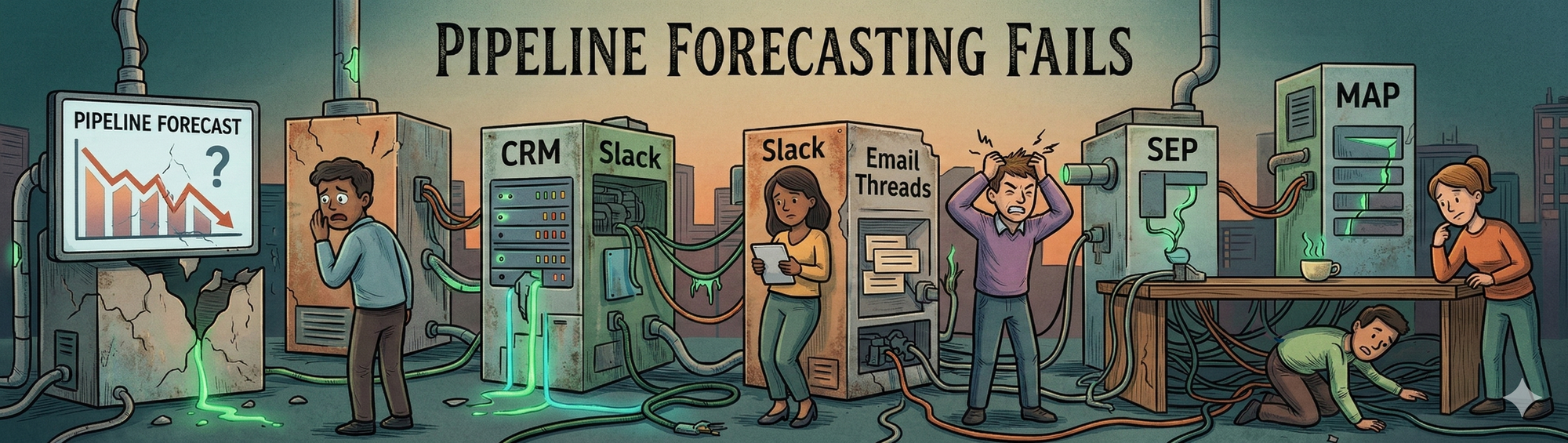
The data exists somewhere in the tech stack (CRM, Slack, Email Threads, SEP, MAP etc.). But it is scattered across tools and connected in a way that does not talk to each other.
Most RevOps teams inherit this problem. The stack was built one tool at a time, each solving a real problem. But rarely does anyone design how those tools should work together, and pipeline forecasting pays for it.
Here are four mistakes that create the gap, and how to fix each one.
(1) No Reliable Source of Truth for your Sales Forecast
Most RevOps teams treat the CRM as a single source of truth. The problem is that most of the actual deal context never lives there.
- Your Reps have deal context in Slack Threads, Email Chains and Sales Engagement Platforms (Salesloft, Apollo, Outreach, Gong, etc.)
- Marketing Automation Platforms (Hubspot Marketing Hub, Marketo, etc.) carry lead and attribution data that rarely stays in sync with the CRM.
- CS Tools (Gainsight, ChurnZero, etc.) flag early churn signals that never make it back to the deal record.
By the time RevOps pulls a sales forecast, they are looking at whatever survived the trip into the CRM, not what actually happened across the revenue cycle.
(2) On-demand Tool Adoption without considering Efficiency
Every tool in your stack was bought to solve a real problem.
However, each tool was evaluated in isolation and nobody asked what the full picture looked like after it was added.
- AI note-taker is adopted to capture context after calls. Call summaries now live in a separate dashboard, adding a new place to check.
- AI forecasting tool (Clari, Aviso, etc.) is adopted because leadership wants better pipeline visibility. But it builds its own model from whatever data it can reach, which disagrees with the CRM.
- n8n or Zapier is adopted as data does not move between platforms on its own. Workflows are wired up over time, and when they break, deals stall before anyone realizes something stopped syncing.
The cost does not show up inside any single tool. It shows up across the entire revenue cycle. Reps toggle between dashboards instead of selling. And RevOps spends its cycles debugging workflows instead of improving them.
(3) Handoff breaks as deals cross teams
SDR to AE. AE to CS. Account owner changes mid-cycle.
Each transition is a moment where deal context not formally described disappears with the person who held it.
- SDR to AE handoffs lose the qualification context that explains why a deal entered the pipeline in the first place. By the time RevOps is trying to call the forecast, there is no record of how solid that foundation actually was.
- AE to CS handoffs lose what it took to close the deal (what was promised, what objections were raised and what the buyer said they needed). When those do not transfer, CS is set up to underdeliver, and the churn that forecast never saw coming follows.
- Account renewals expose the gap between two systems (CS tools <> Sales tools) that were never designed to communicate with each other. What falls between them is the full account history RevOps needs to forecast renewal revenue with any confidence.
Handoff failures do not show up in the forecast as handoff failures. They show up as deals that slipped, renewals that churned, and pipeline that looked healthy until it did not.
(4) Pipeline cleanup that never gets done
RevOps teams spend a significant portion of their week cleaning CRM data (deals stuck in stage for months, close dates that passed weeks ago, contacts with no recent activity, etc.).
But because the cleanup process is structurally reactive, the cleanup never ends however hard RevOps teams work at it.
- Reps have no incentive to mark deals as dead. Keeping a deal open costs nothing in the short term while marking it dead means explaining it. So close dates stay optimistic, pipeline stays padded, and the sales forecast gets around revenue that will never close.
- The CRM itself accumulates debt over time (unused fields that nobody owns, workflow rules that conflict with each other, etc.). Each manual cleanup pass fixes the surface without touching the underlying structure, so the same inconsistencies come back.
How RevOps teams can audit their sales forecast inputs today
You do not need a full project to find the biggest gaps. Run these five questions against your current stack before building another process around it.
- How many tools do you need to check to get the full context on any active deal?
- How many integrations in your stack depend on a manual step to keep the CRM current?
- When ownership changes on a deal, is the context transfer enforced or assumed?
- How many deals in your current pipeline have had no activity in the last 14 days?
- When a deal slipped last quarter, how long did it take to understand why?
The answers tell you where your forecast is running on incomplete inputs. Fix the gap that touches the most deals first.